
By Saket Narnolia, Founder
Missed Call Text Back vs AI Voice Receptionist
Compare missed-call text back and AI voice receptionists for lead recovery, booking, qualification, and follow-up.
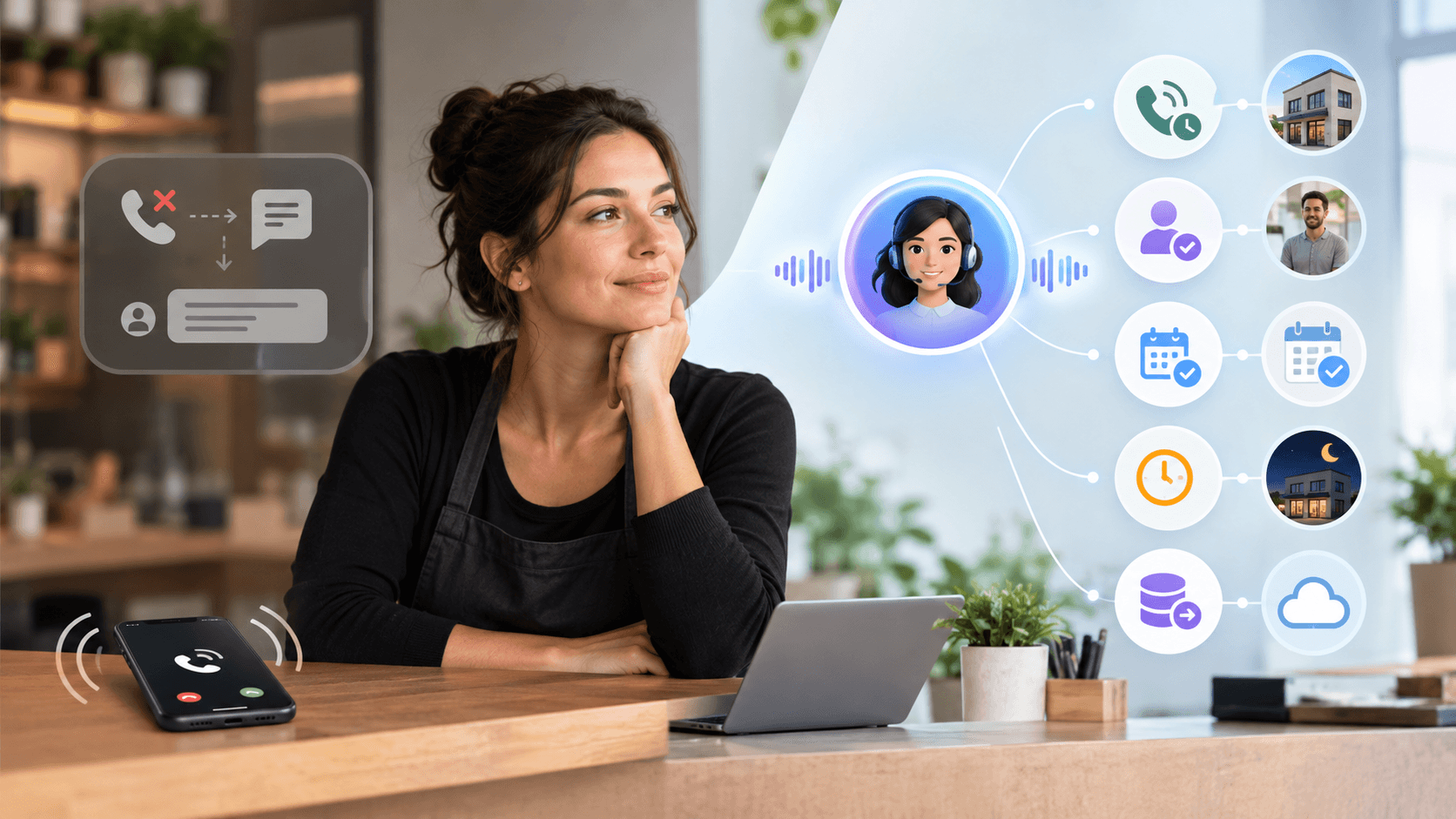
Missed-call text back is best when you only need to acknowledge a missed call and start a simple text conversation. An AI receptionist is better when callers need immediate answers, lead qualification, appointment booking, routing, or follow-up by phone. For complex local-service workflows, a custom AI Voice Employee can handle more of the interaction without requiring a staff member to answer every call.
The practical question is not which technology sounds more advanced. It is what should happen after a call is missed? If the desired outcome is simply to let the caller know someone will respond, text back may be enough. If the caller needs answers, qualification, scheduling, routing, or a complete phone conversation, an AI voice receptionist may be the better workflow.
For most local service businesses, there are actually three choices to evaluate: missed-call text back, an AI voice receptionist, and a human answering service. A fourth option—a cheap self-serve AI receptionist—can also make sense for a solo operator with straightforward needs.
How Does Missed-Call Text Back Work?
A missed-call text-back workflow detects an unanswered call and sends the caller an automated SMS. The message might acknowledge the missed call, identify the business, and invite the caller to reply with what they need.
A basic workflow looks like this:
- A customer calls the business.
- Nobody answers.
- The system detects the missed call.
- An automated text is sent to the caller.
- The caller replies by SMS or waits for a staff member to call back.
- The conversation is handed to a person or another automation when necessary.
This approach is useful because it gives the business an immediate way to acknowledge the caller without requiring an employee to answer the phone in real time.
For example, an HVAC company could send a message such as: “Sorry we missed your call. Reply with your name, address, and what service you need, and our team will follow up.” That can be enough when the caller is comfortable communicating by text and the business does not need to resolve the request immediately by phone.
What Are the Limits of Text Back?
The main limitation is that text back changes the communication channel. The caller started with a phone call, but the recovery workflow asks them to continue through SMS.
That can work well for straightforward requests, but it creates friction when the caller wants to speak with someone. A caller may have several questions, need help deciding which service to book, or expect the business to handle the conversation immediately.
Text also does not automatically solve the operational work behind the request. A message can acknowledge the lead, but someone or something still needs to determine what the customer wants, answer questions, collect information, schedule the appointment, route the request, or follow up.
There is also a compliance consideration. Businesses using automated SMS need an appropriate consent and opt-out process for their messaging use case. For example, Twilio documents standard SMS opt-out handling and consent requirements in its Messaging Policy.
What Does an AI Voice Receptionist Do After a Missed Call?
An AI voice receptionist takes a different approach: instead of asking the caller to switch to text, it provides a phone-based conversation.
Depending on configuration and integrations, an AI voice receptionist can:
- Answer common business questions.
- Ask qualifying questions.
- Collect information about the customer's request.
- Determine whether the inquiry matches a supported service.
- Help with appointment scheduling.
- Route calls to an employee or department.
- Escalate calls when human involvement is required.
- Capture information for CRM follow-up.
- Provide after-hours phone coverage.
The important qualification is that these capabilities are configuration-dependent. An AI receptionist is not automatically capable of booking appointments, updating a CRM, or answering every business-specific question. Those functions depend on the system's knowledge, call flow, integrations, permissions, and escalation rules.
The distinction is therefore less about “AI versus SMS” and more about how much of the customer's task the recovery workflow is expected to complete.
How Is an AI Voice Receptionist Different From a Basic Answering App?
A basic answering application may be designed primarily to take a message or provide a general automated response. That can be useful, particularly for a small business that does not need a complicated call workflow.
A configured AI voice receptionist can go further by turning the phone call into a structured workflow. Instead of merely recording “John called about an appointment,” it might ask what service John needs, collect relevant details, determine whether the request fits a scheduling rule, and then move the caller toward the appropriate next step.
That does not mean the more capable option is always better. If message-taking solves the actual problem, additional workflow complexity can be unnecessary.
Missed-Call Text Back vs AI Voice Receptionist: What Is the Difference?
The clearest way to compare the options is to look at the job each workflow is designed to perform.
| Factor | Missed-call text back | AI voice receptionist |
|---|---|---|
| Primary channel | SMS | Phone |
| Initial recovery | Automated text | Phone conversation, depending on call configuration |
| Simple message-taking | Strong fit | Possible, but may be more than needed |
| Conversation depth | Usually limited to text exchanges | Can support multi-step spoken conversations |
| Lead qualification | Simple questions can be handled by text | Can be configured for structured qualification |
| Appointment booking | Possible with an appropriate SMS workflow and integration | Possible with scheduling logic and integration |
| Caller questions | Answered through text if configured | Answered through voice if configured with the relevant business knowledge |
| Call routing | Usually requires a separate workflow | Can be incorporated into the voice flow |
| After-hours coverage | Text acknowledgment and follow-up | Can provide a phone response and configured follow-up |
| Setup requirements | Trigger, message, reply handling | Call flow, business knowledge, rules, integrations, escalation |
| Best fit | Simple missed-call recovery | Calls requiring conversation or multiple steps |
| Main tradeoff | Caller must continue through messaging | More configuration and operational complexity |
For businesses building SMS workflows, messaging infrastructure also needs to account for consent and opt-out handling. Twilio's documentation, for example, describes STOP-based opt-out handling and consent management for SMS workflows in its Consent Management API documentation.
When Is Missed-Call Text Back the Better Choice?
Text back is often the better choice when the missed-call recovery problem is simple.
Should You Choose Text Back If You Mainly Need Acknowledgement?
If the primary problem is that customers call while the team is busy and need confirmation that their message was received, an automated text may solve the problem without adding a full voice system.
This can be especially reasonable when the business already has a reliable callback process. The text becomes a bridge between the missed call and the employee's response rather than attempting to replace the employee interaction.
Should You Choose Text Back If Callers Can Easily Continue by SMS?
Text back makes sense when customers naturally accept SMS as a communication channel. Simple service requests, callback requests, basic questions, and message-taking can often work this way.
The key test is whether the caller can comfortably provide the information needed without a live conversation.
Should You Choose Text Back If You Are a Solo Operator With Simple Needs?
A solo operator who mainly wants to know that a missed call has been acknowledged may not need a custom AI voice workflow.
A simple text-back system can be easier to understand, configure, and maintain. If the business receives relatively straightforward inquiries and the owner handles scheduling personally, adding more automation may create more operational work than value.
A useful checklist is:
- Do callers mostly request a callback?
- Can customers provide the necessary information by text?
- Are questions generally simple?
- Does the owner already handle booking personally?
- Is message-taking the main requirement?
- Are complex routing and CRM workflows unnecessary?
If most answers are yes, start with text back before buying a more sophisticated system.
When Is an AI Voice Receptionist the Better Choice?
An AI voice receptionist becomes more useful when the business needs the missed-call workflow to do more than acknowledge the caller.
Should You Choose AI Voice When Callers Need Immediate Answers?
If customers frequently call with questions that are already answerable from the business's configured information, keeping the interaction on the phone can reduce the need for the caller to switch channels.
For example, a service business may need to explain what types of jobs it handles, what information is needed to request service, or which department should receive a particular request. A configured voice workflow can guide that conversation.
Should You Choose AI Voice When Qualification Matters?
Lead qualification is a strong reason to consider voice automation.
An HVAC company may need to know the service location, type of issue, equipment information, urgency, and preferred appointment timing. An auto repair shop may need vehicle information and the type of service requested. A home-service company may need to determine whether the requested job falls inside its service area.
Those conversations can be handled through text, but voice may be preferable when the business wants the caller to complete the interaction without manually typing a sequence of answers.
Should You Choose AI Voice When Booking Requires Conversation?
Scheduling becomes more complicated when an appointment request depends on service type, employee availability, location, duration, or other business rules.
An AI receptionist can be configured to collect the information required before attempting to schedule or handing the request to staff. Actual booking capability depends on the calendar or scheduling integration and the permissions given to the system.
If booking is central to your missed-call recovery strategy, review the workflow carefully rather than assuming that any AI receptionist supports your scheduling process.
Should You Choose AI Voice When After-Hours Calls Need Phone Coverage?
After-hours calls are another important distinction. A text-back workflow can tell a caller that the business will respond later. A voice workflow can potentially provide an actual phone interaction during the configured coverage period.
For a business where callers expect immediate assistance or where a missed after-hours lead needs qualification before the next business day, phone-based recovery can be more useful than an SMS acknowledgment.
You can review how a custom workflow can be structured through the MyJarvis AI Voice Employee offering or see a demo.
How Should Dental, HVAC, Auto, and Home-Service Businesses Decide?
The best workflow depends on the type of conversation the business receives, not simply its industry label.
What Should Dental and Clinic Businesses Consider?
Dental practices often receive calls involving appointments, rescheduling, office information, insurance questions, and patient-specific concerns. Routine administrative requests may be appropriate for automation when the workflow is clearly defined.
Sensitive clinical questions and medical triage are different. A business should not assume that an AI receptionist is an appropriate substitute for trained human judgment in situations involving symptoms, emergencies, or complex medical decisions.
For those cases, the workflow should establish clear escalation boundaries.
What Should HVAC and Home-Service Businesses Consider?
HVAC and home-service calls often contain several pieces of information that matter operationally: the service requested, location, timing, job description, and sometimes equipment or property details.
Text back can work when the customer is willing to type the information. Voice automation becomes more attractive when the business wants to collect information conversationally, qualify the request, and move it toward scheduling or dispatch.
What Should Auto Repair Businesses Consider?
Auto repair shops can receive calls about appointments, repair questions, vehicle information, estimates, status updates, and urgent problems.
Simple appointment requests may fit either workflow. More involved conversations may require routing to a technician or service advisor rather than attempting to automate every answer.
The right question is: which parts of the call can be safely standardized, and which require a person?
When Is a Human Answering Service Better?
AI should not be positioned as the right answer for every missed call.
A human answering service can be preferable when the call depends heavily on empathy, nuanced judgment, discretion, or emotional support. Examples include:
- High-emotion customer situations.
- Sensitive legal intake.
- Medical triage.
- Calls requiring nuanced judgment that cannot be reduced to defined rules.
- Situations where the caller specifically needs human reassurance or discretion.
For a clinic, for example, an automated system may be appropriate for routine administrative scheduling while sensitive clinical concerns require escalation to a qualified person.
For legal businesses, intake requirements can be highly specific, and the consequences of misunderstanding a caller can be significant. A human service may therefore be more appropriate depending on the firm's requirements.
The goal should not be to automate every call. The goal should be to automate the calls that can be handled safely and consistently while creating a clear path to a human when they cannot.
When Is a Cheap Self-Serve AI Receptionist Enough?
A custom AI Voice Employee is not automatically the right fit for a small business.
A cheap self-serve AI receptionist may be sufficient when the owner primarily needs basic message-taking, simple FAQs, straightforward call handling, or a basic automated receptionist. This can be a sensible starting point for a solo operator who does not need custom integrations or complex qualification.
A more involved implementation becomes easier to justify when the business needs several connected workflows, such as:
- Missed-call recovery.
- Lead qualification.
- Appointment scheduling.
- Call routing.
- Business-specific knowledge.
- CRM follow-up.
- After-hours handling.
- Defined human escalation.
If those requirements do not exist, MyJarvis may be the wrong fit. A simpler self-serve tool or text-back workflow can be more appropriate.
How Much Setup Does Each Workflow Require?
The technology is only one part of the decision. Implementation requirements can determine whether the workflow remains useful after launch.
What Does Text Back Setup Require?
A basic text-back implementation generally needs:
- A missed-call trigger.
- An SMS message appropriate for the business.
- A way to receive and route replies.
- A defined handoff to staff when needed.
- Optional CRM recording or follow-up.
- A compliant consent and opt-out process for the messaging use case.
The main operational risk is assuming that sending the first text completes the recovery process. Someone still needs to own replies, callbacks, scheduling, and escalation.
What Does AI Voice Receptionist Setup Require?
A voice workflow typically requires more planning because it is responsible for a conversation rather than a single message.
The business should define:
- Which calls the AI should handle.
- What information it should collect.
- Which questions it can answer.
- Which qualification rules apply.
- What scheduling rules apply.
- Which calendar or CRM systems it can access.
- When a caller should be transferred or escalated.
- What happens after hours.
- What information should be recorded for follow-up.
- How the workflow will be tested and monitored.
The biggest implementation risk is an unclear call flow. If the business has not decided what the AI should do with common scenarios, adding voice automation can simply move the confusion into a new system.
How Does MyJarvis Fit This Decision?
MyJarvis is positioned for local service businesses that need more than basic message-taking. Its AI Voice Employee approach is designed around business-specific workflows such as missed-call recovery, reception, lead qualification, appointment booking, and CRM follow-up.
That makes it a better fit when the business wants the phone interaction itself to perform useful operational work rather than simply trigger a text message.
It is not positioned as a low-cost self-serve answering app, and there is no public MyJarvis price to insert into this comparison. The appropriate commercial question is what the business needs the workflow to accomplish and what systems it needs to connect to.
Before choosing a custom implementation, map the current process:
Missed call → customer need → information required → action required → human escalation → follow-up.
If that chain is simple, text back may be enough. If it involves multiple conversational steps, qualification, scheduling, routing, and CRM activity, a custom AI Voice Employee may be worth evaluating.
FAQ
Is missed-call text back better than an AI receptionist?
Neither is universally better. Missed-call text back is usually appropriate when the goal is to acknowledge a missed call and prompt a simple response. An AI receptionist is more useful when callers need immediate conversation, qualification, scheduling, routing, or follow-up. The right choice depends on the complexity of the recovery workflow.
When should a business use missed-call text back?
Use missed-call text back when the business mainly needs acknowledgement, message-taking, or simple lead recovery and callers can comfortably continue by SMS. It is especially suitable when a staff member will handle the substantive conversation later and the business does not need immediate phone-based qualification or scheduling.
What can an AI voice receptionist do that text back cannot?
An AI voice receptionist can conduct a live phone conversation, ask configured qualifying questions, answer supported business questions, route calls, and potentially schedule appointments through an appropriate integration. Text can support many of these tasks, but it requires the caller to continue through messaging rather than having the interaction by phone.
Is an AI receptionist worth it for a small service business?
It depends on call volume, missed-call frequency, appointment value, scheduling complexity, and how much staff time is spent handling calls. A solo operator who mainly needs message-taking may be better served by a simple text-back workflow or inexpensive self-serve AI receptionist than a custom AI Voice Employee.
When is a human answering service better than AI?
Human answering is often preferable when calls involve high emotion, sensitive legal intake, medical triage, nuanced judgment, or situations where empathy and discretion are central. AI can handle defined administrative workflows, but businesses should establish clear escalation rules rather than assuming every caller or scenario is suitable for automation.
Can an AI receptionist handle missed calls after hours?
Yes, an AI receptionist can be configured to provide phone coverage for missed or after-hours calls, subject to its call routing, business knowledge, integrations, and operating rules. This differs from text back because the caller can potentially continue the interaction by phone rather than waiting for a text-based response.
Choose the Right Missed-Call Recovery Workflow
The decision can be reduced to three questions:
- Does the caller only need acknowledgement? Use missed-call text back when a simple message and later human follow-up solve the problem.
- Does the caller need a conversation that can be standardized? Consider an AI voice receptionist when qualification, questions, booking, routing, or after-hours phone coverage matter.
- Does the caller need judgment, empathy, or sensitive expertise? Use a human answering service or human escalation when automation is not appropriate.
For a solo operator with basic needs, a cheap self-serve AI receptionist may be the practical choice. For a business with complex workflows that connect calls, scheduling, qualification, CRM follow-up, and escalation, a custom AI Voice Employee may be a better fit.
If you want to determine which workflow fits your actual missed-call process, book a MyJarvis strategy call for a scoped evaluation of the calls, systems, and handoffs you need to automate.
Want this answering leads while your team is busy?
We can map your missed-call, booking, and follow-up workflow into a practical AI voice employee plan.
Get the automation checklist
A simple checklist for spotting the first workflow worth automating.